Showing posts with label simple. Show all posts

Saturday, 28 January 2012

Four-step baked rhubarb custard recipe


We’ve been in London this week. Kristoph has been super busy finish up various pieces of urgent work, and buzzing around our apartment in a whirlwind. I enrolled in five days of intensive French classes. It’s my latest effort to bring my dream of nattering easily with my French neighbours, in French, closer to reality.

I understand quite a lot of French, but I stumble (and that quite frankly, is a generous interpretation) along in shops and restaurants. I do a lot of nodding, “d’accord” etc. And I’m great on the non-verbal forms of communication. But I can’t converse freely, let alone express myself.

So here I am in London, enrolled in five days of French. It’s intense, just four students, myself included, and a jovial Guadeloupe national named Karine. Karine is passionate about the French language, teaching us French, and hearing us speak to her in French. Her energy is contagious and carries us easily though the four hours each day.

One of Karine’s homework tasks was to listen to as much French material as possible. Obligingly, I tuned our DAB kitchen radio to France Radio London before and after classes each day. Having French on in the background, subtly and gently entering my subconscious, is actually quite lovely. I barely notice it on, until I hear a word that is in my (limited) vocabulary. Then I feel very pleased.

Food has this week been playing second fiddle to my linguistics pursuits. Our dinners have been quick, simple, with few ingredients and little thought. After four straight hours of attempting to move my mind around the nuances of French grammar, I’ve had little motivation to construct complicated dishes.

And so today’s recipe is an abridged version of a Hugh Fearnley-Whittingstall rhubarb and custard tart, included in last week’s Observer. Loving the combination of rhubarb and custard, but without the time to make a sweet pastry case, nor to blind bake it, I dropped the tart. Instead I baked the rhubarb and custard in individual ramekins.

The result is fabulous. The slightly tart rhubarb is complemented beautifully by the citrus tang of the orange juice and rind, and enriched by the vanilla infusion. The finished product – served chilled, is a lovely winter treat.

Here’s the recipe, it makes four individual portions. Hugh’s original tart is available here:

500 grams rhubarb (cut into 5cm lengths)
 Zest of ½ orange
Juice of half an orange
6 tbsp caster sugar
250ml double cream
1 vanilla pod, split (cut it in half, you’ll need half for the rhubarb and half of the custard)
5 egg yolks (save the whites for an egg-omlette)


Step One: Preheat the oven to 200C. Mix the rhubarb, half of the caster sugar, half of the vanilla, the orange rind and the orange juice together in a bowl. Make sure the rhubarb is coated. 


Step Two: Transfer to a roasting tin. Roast for 25-30mins, until the rhubarb is soft. Remove from oven. Then turn the oven down to 130C (you'll need the oven again for the custard). 


Step Three: Make the custard. Heat the cream and the remaining vanilla in a pan until the cream is scalded. Whisk the egg yolks with the remaining sugar, then pour into the cream. Remove the vanilla bean, scraping any remaining seeds into the custard.

Step Four: Place the rhubarb into ramekins, dividing it evenly among the four. Pour over the custard. Bake for 40 minutes, until the custard is set. Pop it in the fridge and serve cold.   

  
Please note that vanilla beans are expensive – so don’t immediately discard them. The spent bean casing will have retained quite a bit of its flavour post use, so dry the two halves out and drop them in some caster sugar to infuse for a vanilla sugar.

Also if you have any rhubarb left over, don’t discard it. Swirl it and it’s juices into yoghurt for an excellent breakfast!

Friday, 9 December 2011

Christmas Baking - Vegetarian Mince Pies


“They dined on mince, and slices of quince
Which they ate with a runcible spoon;
And hand in hand, on the edge of the sand,
They danced by the light of the moon.”
Edward Lear, The Owl and the Pussycat

As a vegetarian, I like to imagine that Edward Lear was writing of mincemeat and mince pies, as opposed to ground beef. As we are now in the season of more moonlight, than daylight, I’ve been baking mince pies. This year I made mince pies that are both vegetable suet-based, and alcohol free.

This is my first attempt at making my own mincemeat, and I used a melange of recipes off the internet, including this one from Delia Smith, to come up with the recipe described below. It takes a while to make, but more in waiting for the flavours to combine, as opposed to actually cooking. As such, it’s a good recipe to prepare while you are baking other items.

In an effort to avoid too much rampant consumption over Christmas, and to tread a little more lightly on the earth, I’m a fan of edible Christmas gifts. I’ll be giving both mincemeat, and mince pies as Christmas gifts this year, as well as some other planned goodies, which I’ll be blogging about in the coming weeks.

Here’s the recipe:
Recipe
Mincemeat
110 grams shredded vegetable suet (available from health food stores)
180 grams raisins
120grams sultanas
120 grams chopped dates
30 grams lemon candied peel
100 grams orange candied peel
180 grams soft dark sugar
Zest and juice of one orange
Zest and juice of one lemon
40 grams almond slivers
One teaspoon ground cinnamon
One teaspoon grated nutmeg
Pastry
200 grams plain flour
Pinch salt
110 grams butter
2-3 tablespoons of cold water
One egg beaten
2-3 tablespoons of caster sugar


Step one:  Combine all the mincemeat ingredients in a large bowl. Mix them together thoroughly. Cover the bowl with a tea towel and leave overnight to allow the flavours to mix together.

Step two: Place the mixture in an oven tray covered with foil and bake for three hours at 120C. As it cools, stir often to ensure the suet coats all of the ingredients.


Step three: Once fully cooled, place the mincemeat in sterilised jars. As this mincemeat is made without alcohol it won’t keep in the cupboard. As such store the mincemeat in the fridge and use within a month.

Step four: To make the pastry, combine the flour, salt, and butter. Need together in a bowl until the mixture resembles breadcrumbs. Add a little water to help the pastry knit together. Roll the pastry into a ball and refrigerate for at least 30 minutes.


Step five: Once the pastry is prepared roll is out. Cut into squares and place the pastry squares into a muffin tray. Cut the edges neatly and re-roll, and set aside to make the pie tops.


Step six: Fill the pies cases with mincemeat, pressing it firmly into each case. Add pie tops in whatever shape you desire. Brush with a lightly beaten egg, and sprinkle a little caster sugar over the top. Cook for 20 minutes at 200C


Sunday, 2 October 2011

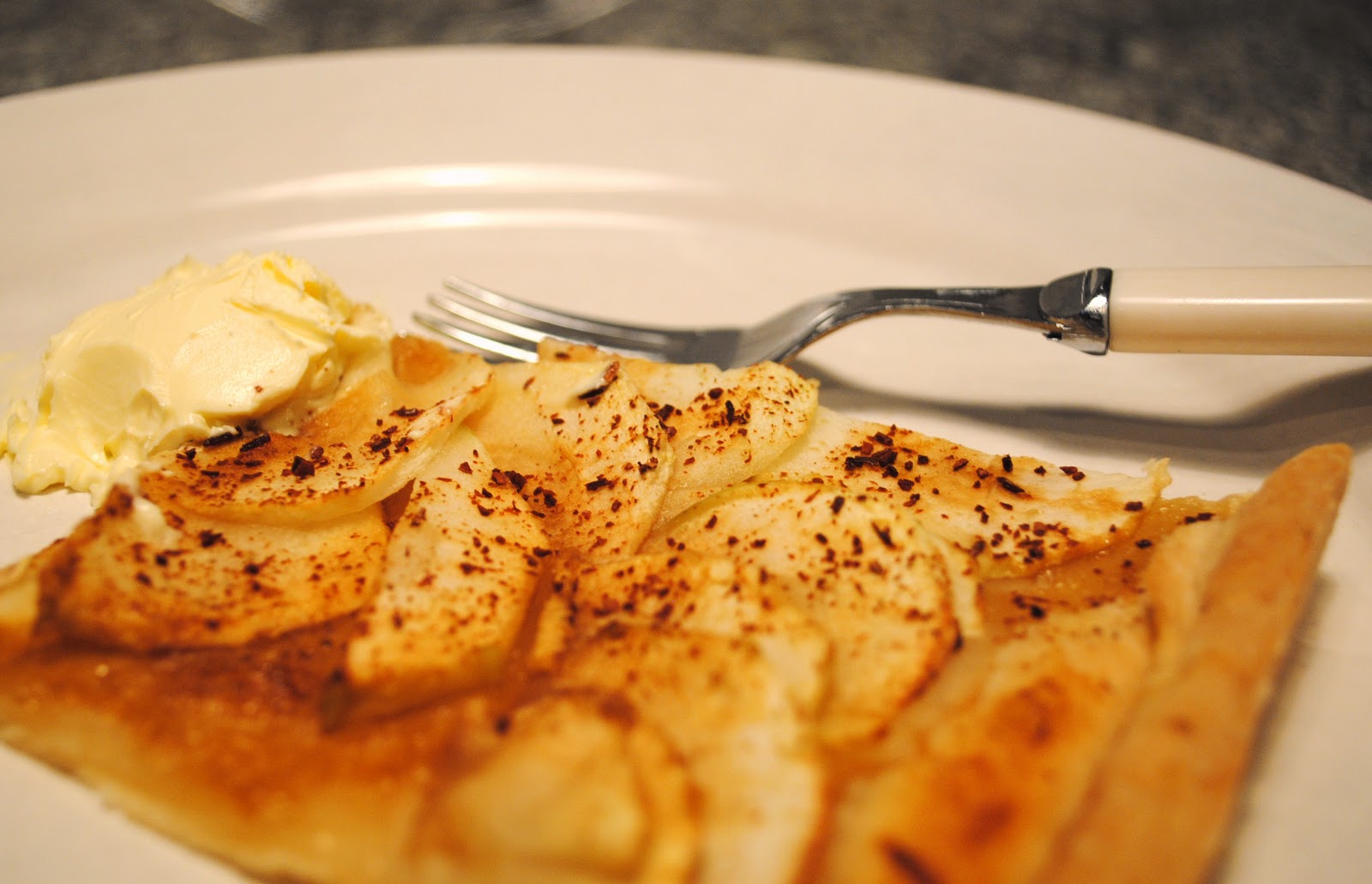
Four Step Rustic Apple Tarte Tatin

In our household we remain slightly over-crowded by apples collected during last weekend’s forage. I’ve been stewing them throughout the week. Today I noticed a roll of short-crust pastry in the fridge that needed to be used, and opted instead for a rustic tarte tatin.

For this recipe I skipped the fancy possible addition of frangipane, delicious as it is. As the apples are flavoursome and fresh, I concluded they should stand on their own. I also omitted the apricot jam glazed used in most French recipes for tarte tatin, sticking instead with fresh ground cinnamon and dark muscavado sugar, to flavour and slightly sweeten the apples.

This tart was constructed in less than 15 minutes, and has just four very simple steps.

The result, according to Kristoph, was "very tasty." A perfect dish to serve with afternoon tea, or as a quick dinner party dessert. It will serve 6 people.  


Recipe
5 green sour apples, peeled, cored and sliced thinly
1 pack 375gram shortcrust pastry
1 Cinnamon stick, ground
1 lemon
3 tablespoons dark muscavado sugar
Flour (for rolling the pastry)

Step 1. Start by rolling the pastry into the shape of your baking tray (I used a tray approximately 30cm x 20cm). Cover the tray in baking paper, and lay the pastry on top.


Step 2.  Slice the apples and soak then in the lemon juice. Once soaked add two tablespoons of the sugar and mix thoroughly through, with your hands.

Step 3. Arrange the apples. Start in the centre and work out in a circular shape. Most French tarts look perfect, but we’re making a rustic tart, so don’t be too precious. Then sprinkle the cinnamon over the top, together with the remaining sugar.


Step 4. Cook the tart at 180C. It will likely take between 20-25 minutes, depending on your oven. You’ll know it’s ready when the pastry is golden, and your kitchen is smelling of delicious cinnamon and baked apple.  


If you make this, please do write and tell me what you think, how you change it, and how it turns out!