Showing posts with label rosemary. Show all posts

Wednesday, 1 February 2012

Vanilla scented lemon and rosemary shortbread cookie recipe


Happy February everyone! It’s officially the last month of winter - in this northern hemisphere anyway. While I have been enjoying the crystal clear days, blue skies and frosty mornings, I’m desperate for spring. Even in my new (vintage) shearling coat I fill chilled to the bone. Added to this I’m desperate for the scent of flowers, the sight of leaves on trees, the sound of birdsong, and the taste of foraged goodies. 

Through the short days when there is barely anything to pick or forage, rosemary has been my readily available, abundant friend. Up the narrow, cobbled, medieval lane behind our house there is a rosemary bush growing innocently, and rather triumphantly, out of an old stone wall. It’s not really owned by anyone, the ancient house overhanging it is long deserted, and most of it is growing over the steep cobbled public path.   

I’ve been focused on finding new uses for rosemary all winter. A couple of weeks ago I attempted a lemon and rosemary possett, and while the fusion of lemon and rosemary was fabulous, there were some texture issues. Cream in France is dissimilar to English cream, and I’m still searching for something that will set. Nevertheless, I’ve come across several recipes for lemon and rosemary shortbread and cookies recently. And there are no cream issues with cookies! 

We’re heading to Munich tomorrow morning for a few days to visit my good friend Alice who recently gave birth to gorgeous twin daughters. They’ve been suffering a little with the long Bavarian winter. So I thought I would bake and take with me some cookies, along with a bunch of organic decaffeinated teas that Alice has been missing in Munich.    

The recipe I used is an adaptation from one I found over at Pete Bakes. I chopped and changed a couple of things, adding vanilla seeds, as opposed to vanilla essence to give the cookies a slightly more decadent edge. I also rolled the cookie dough log in chopped rosemary, vanilla sugar and finely chopped rosemary to infuse the edges with an extra zing.

The result? Perfect little cookies that travel well, flavoured with earthy rosemary, which balances beautifully with zingy lemon zest. Beware these cookies are so tasty that once you start eating them it’s really difficult to stop. So before you bake, make sure you’ve got somewhere to take them, or people to share them with.   
The recipe makes around 40 small cookies. You can also roll the dough log and leave it in the fridge for a few days, if you fancy serving the cookies hot.

Recipe
1 cup of unsalted butter (room temperature)
3/4 cup raw cane sugar
2 1/4 cups plain flour
1 egg
½ vanilla bean
1 tbsp fresh rosemary, finely chopped
2 tsp grated lemon zest
1/2 tsp salt
2 tsp vanilla sugar

Step one: Chop the butter into small cubes and together with the cane sugar place in a large mixing bowl. Use a hand mixer to mix the sugar and the butter until the mixture is pale and light in colour.  


Step two: Then add most of the egg, vanilla seeds, salt, sifted flour, and most of the lemon zest and rosemary (hold a little back to roll the dough log through), and mix together. Once the flour is added the dough will morph into a consistency you can knead.
 
Step three: Roll the dough into a log, seal with plastic cling film and refrigerate for an hour or longer.  

 
Step four: Set the oven to 180C. Scatter the remaining lemon zest, rosemary and vanilla sugar on a clean surface. Remove the log from the fridge, unwrap it and roll through the mixture, lightly covering the outside of the log. 


Step five: Once it’s covered line a baking tray with aluminium foil, or baking paper. Cut the log into 5mm slices and place on the baking tray. Bake for 12 minutes, and then cool on a wire rack.   


What do you think? Any other cookie combinations you can recommend?  Or just leave me a comment so I know you stopped by! thanks 

Friday, 23 December 2011

Savoury Carrot, Goat Cheese and Caramelised Onion Loaf


Last weekend I co-hosted a pre-Christmas dinner with friends in Segur le Chateau. I was requested to make my savoury pumpkin and blue-cheese muffins. I wondered however what course my savoury muffins would fit within. My lovely friends Vicky and Charlie, and owners of the venue for pre-Christmas dinner, La Durantie, assured me that the muffins would be work well with aperitifs. 

I was even more perplexed – muffins and gluhwein, could they really work together?

Perhaps I should explain the background of the request. I recently sent, Vicky, Charlie and Vicky’s husband Ralph, off on their holiday with a bag of savoury muffins. The muffins were deemed as a delicious road-trip snack, and the girls were keen to try them again – hence the request to make them for our dinner guests.
I felt uncertain about the muffin and gluhwein pairing, worried I’d frighten the French guests, and perhaps confuse everyone else. Eventually we agreed I’d make the muffin recipe, but as a savoury loaf.   

As it happened however, I was unable to source a decent pumpkin. The piles of pumpkins seen all around Segur two months ago seem to be no longer. Carrots however, were plentiful. So I substituted carrots for pumpkin, goats cheese for blue cheese, and added caramelised onions.

The end product was a success. We served the loaf cut in bit-sized morsels – with the gluvine. The loaf was both sweet and savoury, with the sweetness of the onion working well against the creaminess of the goats cheese.    
      
Recipe
2 cups grated carrot
½ cup caramelised onion (around four small brown onions)
1/3 cup grated parmesan
1/2 cup chopped rosemary
1/2 cup crumbled goats cheese
2 eggs
1 cup milk
Ground black pepper
Sea salt
2 cups plain flour
2 table spoons mustard
Baking powder

Step 1: pre-heat the oven to 180C. Great the pumpkin and set aside. Caramelise the onion.


Step 2: Combine the chopped rosemary, mustard, goats cheese, caramelised onions and parmesan. Add most of the carrot, save a little (to top the loaf later). 

Step 3: Sift the flour and the baking powder, then stir into the mixture.

 
Step 4: In a separate bowl, lightly beat the eggs and milk together. Then add to the mixture. Add salt and pepper. Then stir in slowly, folding the ingredients together gently.


Step 5: Add the mixture to your (greased) loaf tin. Cook for 40 minutes.  

Thursday, 22 December 2011

Honey roasted heirloom carrots with moutarde violette dressing


We’re hunkering down for winter in Segur le Chateau. The new log burner is pumping out much needed warmth on these damp days. Despite the stark beauty of the village in the depths of winter, the recent rain has felt slightly repressive. In the last week we’ve had four consecutive days of solid rain. The usually gently meandering Auvézère was transformed into a fast-flowing torrent of water threatening to burst its banks.     

In a search at the local market for comfort food, I was delighted to come across these multi-coloured heritage carrots. In deep indigo, bright yellow, and orange, they immediately brightened my day. Apparently, before large-scale farming became the norm, diverse varieties of carrots were found across the world. With the indigo, or purple carrot being very common in Afghanistan, pink in India, and white and yellow carrots most commonly found in Europe.

In terms of nutrition, the Helpful Gardener says that purple carrots are filled with the antioxidants of blueberries! I’ll certainly be planting some of these come February.

I love the flavour of carrots, and was keen to avoid overpowering these colourful carrots with too many flavours. As such, I prepared them simply by roasting them in olive oil, honey and fresh chopped rosemary. I also made a quick sauce with locally made violet mustard and natural yoghurt.

Here’s the recipe.     
Recipe
1 Kg heirloom carrots (or regular if you can’t find heirloom)
Handful of fresh picked and chopped rosemary
Glug of olive oil
Two table spoons honey
Dressing: Two tablespoons natural yoghurt, and a ½ a tablespoon violet mustard

 
Step 1: Clean and peel your carrots


Step 2: Chop carrots into strips. Place in a baking tray and coat with honey, olive oil and rosemary. Season well.

Step 3: Roast for 30 minutes at 180C.

Step 4: For the dressing mix the natural yoghurt with the moutarde violette and serve at room temperature. 


Monday, 12 December 2011

Christmas Baking - Delicious Rosemary and Pine Nut Brittle


I seem to have been surrounded by rosemary and rosemary recipes over the last few days. First, I read a piece on rosemary infused olive oil, then on rosemary sugar syrup – that can be added to the very festive gin fizz, and then I came across this delectable rosemary and pine nut brittle on Food52 (which recently featured this blog, in their "Best of the Blogs" section). 

Perhaps it’s the time of year. The fragrance of rosemary certainly evokes in me Christmassy associations, and the herb is said to symbolise friendship and remembrance. A great friend of ours actually visited yesterday, delivering handfuls of fresh rosemary, cut that morning from her plant.

But I digress, back to the Rosemary and Pine Nut Brittle. Submitted by Ms T, who writes the Still Simmering blog, this recipe was voted best holiday recipe on Food52. There’s no doubt it’s well-deserved. As I read the recipe, and looked at the pictures, my mouth was quite literally watering. And, as it’s got less than five ingredients, all of which happened to already be in my store cupboard, I jumped off my seat and immediately made it.

Recipe:
2 cups sugar
2 1/2 cups pine nuts
8 tablespoons (one stick) unsalted butter
1 tablespoon finely chopped fresh rosemary
1 tablespoon finely ground sea salt (I used Maldon sea salt)

Step 1: Place the sugar in a large, heavy saucepan over high heat and stir with a wooden spoon until sugar begins to melt. Lower the heat to medium, and stir until the sugar is melted. Stop stirring and watch for it to turn a medium caramel colour, this takes a few minutes.

Step 2: Stir in pine nuts and the butter. Allow pine nuts to cook for about two minutes – keep stirring. Stir in half of the rosemary and half of the sea salt.


Step 3: Pour the mixture out onto a sheet pan lined with baking paper. Spread it evenly to the desired thickness with a wooden spoon or stiff rubber spatula – Mine was around 4mm thick. Sprinkle remaining rosemary and salt on top, while the brittle is warm.

Step 4: Allow to cool completely. I’m impatient, so I cooled it in the fridge. After an hour or so it should snap easily.

Warning: this brittle is addictive! Both a positive and negative trait. It’s impossible to stop with just one piece. To avoid too much over indulgence, I put in jars, and made it into Christmas gifts immediately. I have to confess, I then opened one and started nibbling... but at least I tried. 


Monday, 17 October 2011

Sunday Lunch at La Durantie – Part II

In Part I of this post, I focused on the baked figs that I prepared as part of Sunday lunch with friends at la Durantie. Not surprisingly, there was more, prepared by the Good Doctor.

Our original plan was for Kristoph and the Good Doctor to embark on a Sunday “chicken stuff-off,” using some local chickens. Kristoph’s recent thumb injury however, precluded his active participation, and the Good Doctor was left to stuff his chicken alone.

I should add here that I’m a pretty committed pescatarian. I’ve been eating fish for around three years, and for the 15 years before that, I was fully vegetarian. I stopped eating meat when I was around 13 years old, questioning its necessity in our diet. My youthful self summised that if I lived with a tribe and hunted for my own food, I’d probably be okay with it, but until then, I’d stick with vegetables.

My move to include fish in my diet was encouraged by Kristoph. I was hesitant, due to the alarming state of some fish stocks and my need to feel confident and comfortable with the source of my food. So now I eat fish including local farmed trout, mackerel, anything in abundant supply, fished from not too distant seas. In honour of my 13 year old self’s ideals; I’m also comfortable with catching and killing fish by my own hand.        

Alas, I digress. Back to the Good Doctor’s chicken. South-west France is a land of rolling hills, sprawling and tangled woodlands, limousine beef cattle and ducks, “cul noir” pigs, among other animals. Most live comfortable and happy lives. And while I personally choose not to eat these animals, I recognise their importance to both the economy and culture of this region.

The Good Doctor knows his chicken (098684 to be precise) and its provenance.


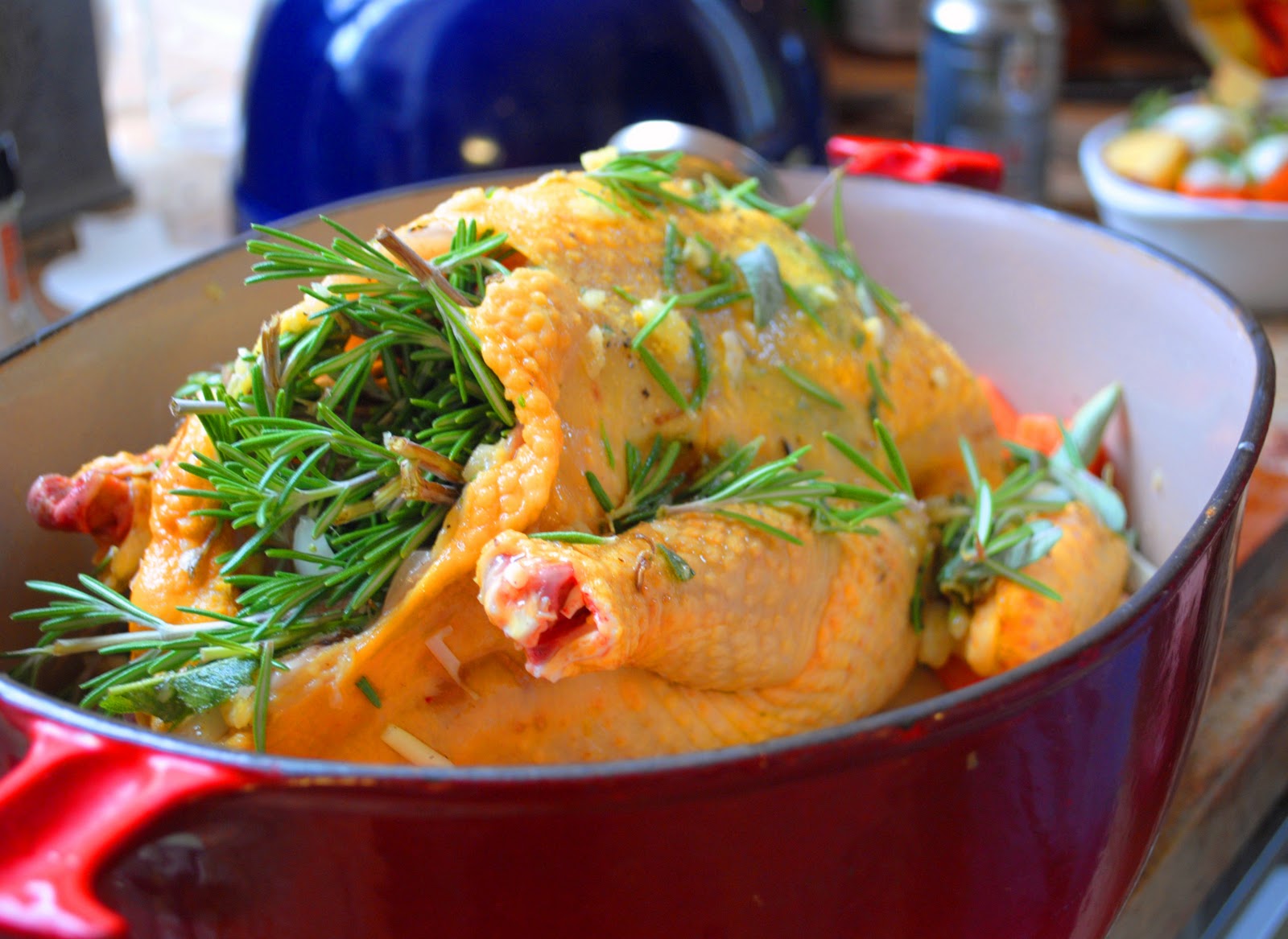
The stuffing was prepared by mashing together, with a mortar and pestle, handfuls of onion, garlic, rosemary, sage, a generous amount of black pepper. This mix was then stuffed inside the chicken, and rubbed over its outside.  


Once prepared the chicken was roasted for around two hours, together with potatoes, onions and carrots, also mixed with rosemary and sage. 

 
We also boiled up some leaks from the farm shop down the road. These were simply chopped and boiled for a few minutes in butter.


All in all, a long, lazy, slow-cooked and very enjoyable Sunday lunch, ended with four full and satisfied bellys, and a game of pool.