Saturday, 29 October 2011

Damson bread and butter pudding


I had no idea what a damson was until September this year. This ancient and sour plum does not grow in Australia, so I was thrilled when friend’s Randolph and Lalu showed me their damson tree a few weeks ago. That was a big foraging weekend, so the damsons went straight into the freezer, until I figured out what to do with them. 


According to my recently purchased copy of Forgotten Fruits, by Christopher Stocks, damsons likely originated close to the the Syrian city of Damascus. Damsons are too sour to eat raw and therefore often used in cooking and jam making. Historically the juice was also used by the textile industry.

A quick internet search indicates damsons can be used to make damson gin, vodka and beer, and to make jam. But it was a recipe for damson bread and butter pudding that caught my eye. Bread and butter pudding is one of Kristoph’s favourite desserts, so this damson version was potentially a household hit.  

I modified the recipe slightly, here’s my version.

Recipe
100g butter
8 thin slices white loaf, crusts removed
150g fresh or frozen damsons (I used frozen and thawed them over night)
3 eggs
3 egg yolks
1 vanilla pod
200g caster sugar
400ml single cream

Step 1: Grease and sugar a six-inch by four-inch ovenproof dish.

Step 2: Butter each slice of bread. Cut each in half to make triangles.

Step 3: Remove the damson stones.


Step 4: Layer with the bread, a good sprinkling of sugar, damsons, bread, sugar damsons, etc, until the bread, the damsons, and half of the sugar, are used up. Sprinkle the top with sugar.

Step 5: Beat the eggs, egg yolks, vanilla and remaining caster sugar in a bowl. Heat the cream to just before boiling. Pour it over the eggy mixture and stir gently.


Step 6: Pour the eggy mixture over the pudding, and leave to stand for 30 minutes. Preheat the oven to 180C/350F.

 
Step 7: Place the pudding dish in a baking dish filled with water. Cook for 40 minutes until the custard sets.

Serve this warm with cream, or Greek yoghurt. According to Kristoph the damsons are tastier than the usual sultanas in bread and butter pudding. Enjoy!

Do you have any great damson recipes? If so, please leave them in the comments box. I’d love to try them.

Thursday, 27 October 2011

Healthy and delicious broccoli and feta salad


I heart broccoli. It’s true. It’s green, good for me, and I often crave it. Broccoli is apparently one of the healthiest foods around, a “nutritional powerhouse.” Eating it makes me feel quite virtuous. I prefer broccoli steamed, to retain the powerhouse of nutrients, and because to me it tastes better. 

This salad is super simple, extremely tasty and takes less than ten minutes to make. I often have it for lunch on a weekday, but it’s also attractive enough to serve as a warm side dish at a dinner party. This salad also chills well and makes an excellent, colourful and nutritious addition to any BBQ. At this time of year though, I prefer my broccoli warm and straight from the steamer.

When buying broccoli make sure it’s crisp and bright. Avoid any broccoli that is a little saggy, or has lost its vibrant colour. And if you can, buy organic. Here’s the recipe.


Recipe
(Serves one hungry person, or two as a side dish)
One large head of broccoli
25grams Greek feta cheese
One small red pepper
15 black Greek olives
Juice of one lemon
Glug of olive oil
Ground black pepper 

Step 1 – Bring a medium size saucepan to the boil, and cover with a steamer. Chop the broccoli into florets and drop into the steamer. Using a pair of tongs, move the broccoli around every minute or so to ensure all of the florets are steamed. You’ll see the broccoli change colour from a dark green to a vibrant green. After five or so minutes taste a floret. When the broccoli is ready, it will taste crisp, but not raw. 


Step 2 – While the broccoli is steaming, chop the feta and slice the peppers. Mix the lemon juice with a glug of olive oil.

Step 3 – Transfer the steamed broccoli to a bowl. Stir in the peppers, feta and olives. Pour over the olive oil and lemon juice mixture and add ground black pepper to taste. Enjoy!


Sunday, 23 October 2011

Cocktail hour - berry infusion


Over the last year or so I’ve reintroduced cocktail hour. When I want to morph into an old French man, I opt for a Ricard over ice, with a dash of water. I put my feet up, grab a deckchair and lounge in the courtyard, and dream the day away.

I don’t always want to feel like an old French man though. On other evenings I lean towards our house cocktail, more of a ladies drink really, a combination of a dryish Alsace Riesling and a dash of locally made raspberry liqueur.

Recently however, I’ve been craving an aperitif with a heavy burst of vitamin C, to both recharge and relax. It’s on these days that I scour the fridge and freezer for foraged berries. I tip them all into a glass and use a hand blender to puree them. While that’s happening I add a shot of Icelandic vodka, apparently distilled through basalt, and a little more ice.

The result – a slightly naughty version of a very healthy juice!         

Bon weekend!


Monday, 17 October 2011

Sunday Lunch at La Durantie – Part II

In Part I of this post, I focused on the baked figs that I prepared as part of Sunday lunch with friends at la Durantie. Not surprisingly, there was more, prepared by the Good Doctor.

Our original plan was for Kristoph and the Good Doctor to embark on a Sunday “chicken stuff-off,” using some local chickens. Kristoph’s recent thumb injury however, precluded his active participation, and the Good Doctor was left to stuff his chicken alone.

I should add here that I’m a pretty committed pescatarian. I’ve been eating fish for around three years, and for the 15 years before that, I was fully vegetarian. I stopped eating meat when I was around 13 years old, questioning its necessity in our diet. My youthful self summised that if I lived with a tribe and hunted for my own food, I’d probably be okay with it, but until then, I’d stick with vegetables.

My move to include fish in my diet was encouraged by Kristoph. I was hesitant, due to the alarming state of some fish stocks and my need to feel confident and comfortable with the source of my food. So now I eat fish including local farmed trout, mackerel, anything in abundant supply, fished from not too distant seas. In honour of my 13 year old self’s ideals; I’m also comfortable with catching and killing fish by my own hand.        

Alas, I digress. Back to the Good Doctor’s chicken. South-west France is a land of rolling hills, sprawling and tangled woodlands, limousine beef cattle and ducks, “cul noir” pigs, among other animals. Most live comfortable and happy lives. And while I personally choose not to eat these animals, I recognise their importance to both the economy and culture of this region.

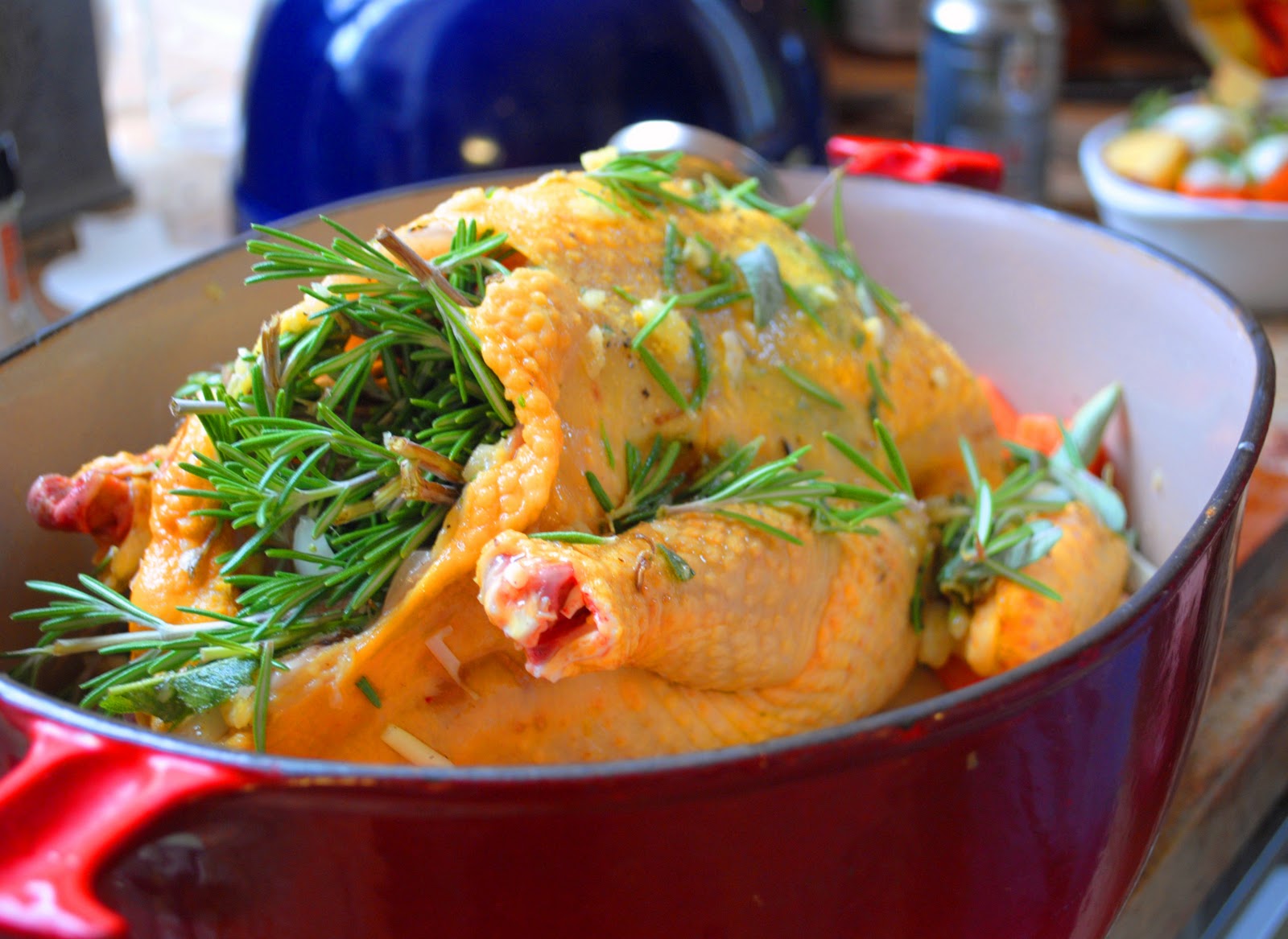
The Good Doctor knows his chicken (098684 to be precise) and its provenance.


The stuffing was prepared by mashing together, with a mortar and pestle, handfuls of onion, garlic, rosemary, sage, a generous amount of black pepper. This mix was then stuffed inside the chicken, and rubbed over its outside.  


Once prepared the chicken was roasted for around two hours, together with potatoes, onions and carrots, also mixed with rosemary and sage. 

 
We also boiled up some leaks from the farm shop down the road. These were simply chopped and boiled for a few minutes in butter.


All in all, a long, lazy, slow-cooked and very enjoyable Sunday lunch, ended with four full and satisfied bellys, and a game of pool.   

Monday, 10 October 2011

Sunday Lunch at la Durantie – Part 1

Kristoph and I enjoyed Sunday lunch this weekend with the Comtesse de la Tour and the visiting Good Doctor. They’re taking care of Chateau la Durantie this week, the home of some close friends of ours, and their three dogs.

There are plenty of vegetables and herbs growing in the grounds of Durantie, and literally thousands of apples, pears and quinces falling from the trees in the orchard.

The Good Doctor and Kirstoph agreed some time ago to a competitive “chicken stuff-off,” however Kristoph’s recent thumb injury, means his thumb is encased in plastic and not at its best for chicken stuffing. Consequently, the Good Doctor took the lead in chicken stuffing, with Kristoph offering comments, commentary and general moral support.

I prepared a fig and chevre starter, with figs foraged from a neighbour’s tree, and an apple and raspberry crumble using fruits from Durantie, for dessert. I’ve blogged about crumbles quite extensively, and so in this post have focused on the fig and goats cheese starter. Part 2 of this post focuses on the Good Doctor’s stuffed chicken and roasted autumn vegetables.  

It’s hard to beat the silky sweet taste of figs picked directly from the tree. Figs are extremely perishable, because the best tasting figs are plump and mushy. So if you have a fig tree near you, I suggest keeping a close eye on it. When the fruit are ripe, spend a few minutes enjoying figs directly from the tree. Perhaps ponder the words of "each man under his own vine and fig tree" (1 Kings 4:25), which have been used to denote peace and prosperity.   

Baked figs are simple to prepare. Here’s my version of baked fig and goats cheese.


Recipe
10 figs
1 small disc of full flavoured medium-hard goats cheese
Honey
Ground black pepper


Step 1: Preheat the oven to 180C. Slice the figs in half and arrange on a baking tray.

Step 2: Chop the goats cheese in small cubes. Place one cube in the small hole inside the small depression in each fig.

Step 3: Drizzle the honey over each fig, and then grind pepper over the figs.

Step 4: Bake for 15 minutes until the figs begin to caramelize and the goats cheese is melted.


If you are lucky enough to have an open fire, I recommend eating these as finger food in front of the fire with a glass of Cote du Rhone.Enjoy!!

Friday, 7 October 2011

Pumpkin and blue cheese savoury muffins

Muffins again I hear you mumble.... well, perhaps I could have made something else, but two events serendipitously occurred yesterday that led to these savoury treats. 

The first, occurred as I was reading through some food blogs and found a recipe from some Kiwi’s currently based in Melbourne, my home town. They’ve self-published a cook book entitled Martha Goes Green. The recipe was for pumpkin and feta savoury muffins. I do love a savoury muffin, but it’s been quite a while since I’ve had one.

In my Melbourne University days in the mid-1990’s, I worked at the Rathdowne Street Food Store. Each day we’d serve up varying combinations of sweet and savoury muffins. Those staff lucky enough to be working late, would take home any leftovers.  At that point I lived on Lygon Street in a giant terrace with six male engineering students. Needless to say, when Foodstore goodies arrived home, it was a harmonious, if not slightly overcrowded, happy house.

Savoury muffins are not so common in Europe. In fact I don’t think I’ve ever come across one. The recipe in Martha Goes Green managed to remind me of a forgotten favourite, and also left me with the bitter-sweet taste of nostalgia for Melbourne, and days gone by.   

And so, I went about my morning yesterday, trundling about the woods and the village, in my wellies, thinking of Melbourne, but also of the astounding beauty and colours of autumn in France.


The second serendiptious event occurred when I arrived on the Comtesse de la Tour’s terrace. I was greeted by an incredibly bright pile of squash, arranged an a still life. I was very pleased when I learned these were a gift from another very lovely neighbour. She thought I might like to photograph them and then make something tasty.


Well, yes indeed I would! And did!

And so, pumpkin and blue cheese muffins were made in Segur le Chateau, for perhaps the first time. I have to confess, I was inspired by the recipe in Martha Goes Green, but added and subtracted a few bits and pieces. Fetta is not common here, but blue cheese is abundant. Here’s my version:
 
Recipe
2 cups chopped pumpkin
Glug of olive oil
A little butter
1/2 cup chopped parsley
1/2 cup crumbled blue cheese
2 eggs
1 cup milk
Ground black pepper
Sea salt
2 cups plain flour
2 table spoons mustard
Baking powder

Step 1: pre-heat the oven to 180C. Chop the pumpkin into small cubes. Toss the cubes in olive oil, seat salt and pepper. Roast for 25 minutes. 

Step 2: Mix the parsley and the mustard. Add most of the pumpkin (once it’s cooled), save 12 cubes (to top the muffins later). Then add most of the blue cheese, again save 12 cubes.

Step 3: Sift the flour and the baking powder, then stir into the mixture.

Step 4: In a separate bowl, lightly beat the eggs and milk together. Then add to the mixture. Add salt and pepper. Then stir in slowly, folding the ingredients together gently.

Step 5: Add the mixture to your (greased) over tray. Cook for 20 minutes.


PS – If you are in Melbourne reading this, feel free to leave me a comment on the Foodstore. Is it still good? I recently read that it is, but is filled with overpaid 30-somethings attempting to recreate their 20-something selves... doesn’t sound all bad.

Tuesday, 4 October 2011

Tangy Apple and Blackberry Muffins

I’ve been feeling a bit overwhelmed by the volume of apples currently smiling up at me from our dining room table. Perhaps it’s a bit of forager’s guilt... 

Did we collect too many? More than we can eat? How many apples do two people really need?

So today I made another effort to use up our collection of wind-fallen apples, by making apple and blackberry muffins. Our local blackberry bramble is still ripening, so we pop over every couple of days to collect another lot. We never seem to have too many blackberries.   


Back to the muffins. A quick search online indicated that recipes for twelve muffins often contain a cup of vegetable oil. I’m just not interested in consuming vegetable oil. So the following recipe is a melange of several I found online substituting ingredients in and out. 

The result, a sweet muffin offset by the tangy apples and blackberries. Delicious warm or cold! 

Recipe
300grams plain flour
1 tablespoon baking powder
1 egg
Pinch of salt
190grams brown sugar
230ml butter milk
100grams melted butter
250grams bramley apples (chopped into 1cm chunks)
150grams blackberries

Step 1: Preheat the oven to 180C. Sift the flour and baking powder into a mixing bowl. Stir in the sugar and salt.

Step 2: Beat the egg, butter milk, butter.

Step 3: Stir the wet mixture into the flour mixture with a big wooden spoon. Drag it round slowly, making sure the ingredients are well mixed. Then drop in the apple pieces and blackberries and stir again.The mixture will change colour from cream to purple. Very satisfying.


Step 4: Spoon mixture into a muffin tray, lined with baking paper, or paper cases. 


Step 5: Bake for 20-25 minutes, until the tops are golden brown.Let them cool for a few minutes and eat the first one warm!


Sunday, 2 October 2011

Four Step Rustic Apple Tarte Tatin

In our household we remain slightly over-crowded by apples collected during last weekend’s forage. I’ve been stewing them throughout the week. Today I noticed a roll of short-crust pastry in the fridge that needed to be used, and opted instead for a rustic tarte tatin.

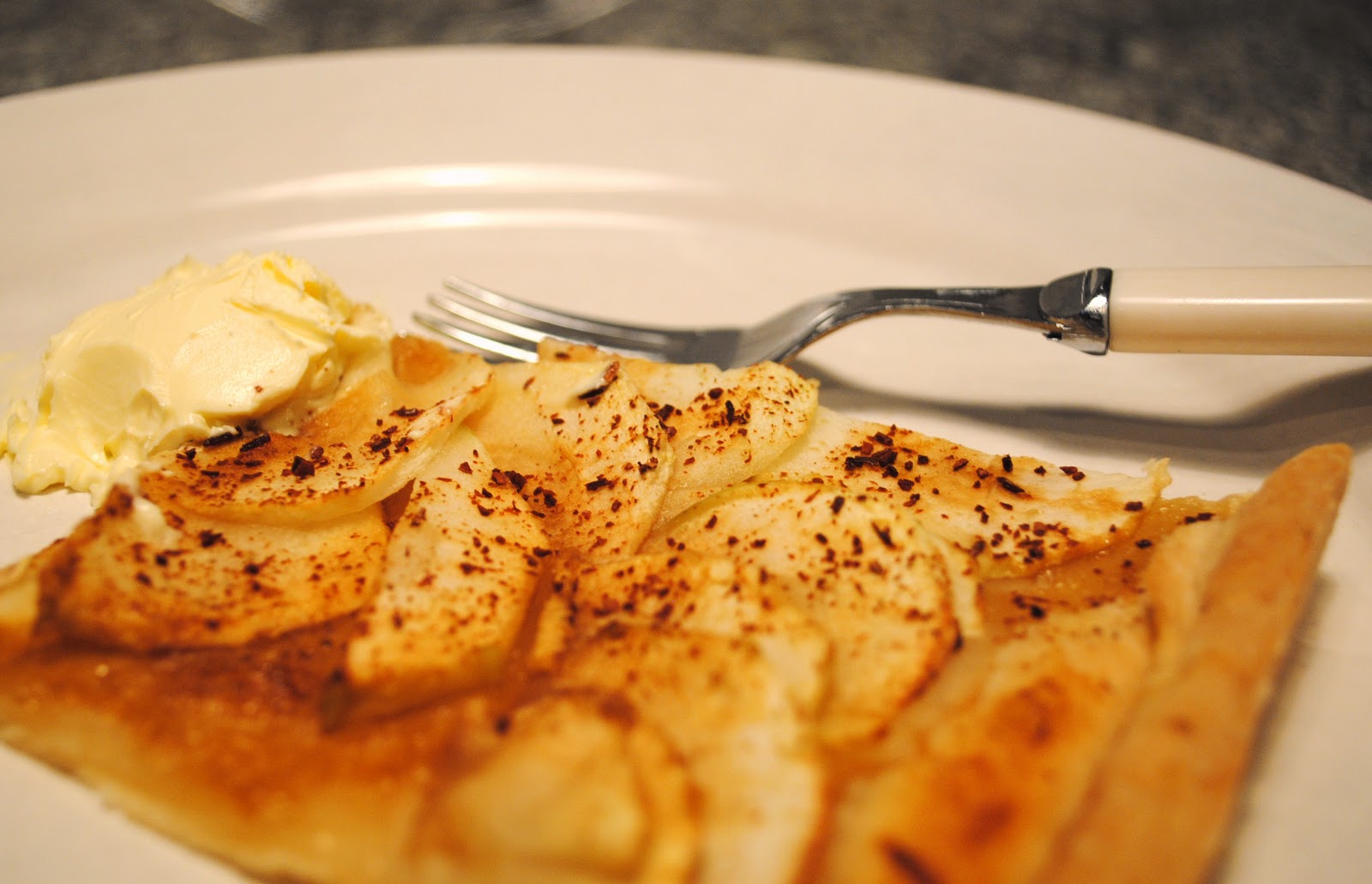
For this recipe I skipped the fancy possible addition of frangipane, delicious as it is. As the apples are flavoursome and fresh, I concluded they should stand on their own. I also omitted the apricot jam glazed used in most French recipes for tarte tatin, sticking instead with fresh ground cinnamon and dark muscavado sugar, to flavour and slightly sweeten the apples.

This tart was constructed in less than 15 minutes, and has just four very simple steps.

The result, according to Kristoph, was "very tasty." A perfect dish to serve with afternoon tea, or as a quick dinner party dessert. It will serve 6 people.  


Recipe
5 green sour apples, peeled, cored and sliced thinly
1 pack 375gram shortcrust pastry
1 Cinnamon stick, ground
1 lemon
3 tablespoons dark muscavado sugar
Flour (for rolling the pastry)

Step 1. Start by rolling the pastry into the shape of your baking tray (I used a tray approximately 30cm x 20cm). Cover the tray in baking paper, and lay the pastry on top.


Step 2.  Slice the apples and soak then in the lemon juice. Once soaked add two tablespoons of the sugar and mix thoroughly through, with your hands.

Step 3. Arrange the apples. Start in the centre and work out in a circular shape. Most French tarts look perfect, but we’re making a rustic tart, so don’t be too precious. Then sprinkle the cinnamon over the top, together with the remaining sugar.


Step 4. Cook the tart at 180C. It will likely take between 20-25 minutes, depending on your oven. You’ll know it’s ready when the pastry is golden, and your kitchen is smelling of delicious cinnamon and baked apple.  


If you make this, please do write and tell me what you think, how you change it, and how it turns out!